

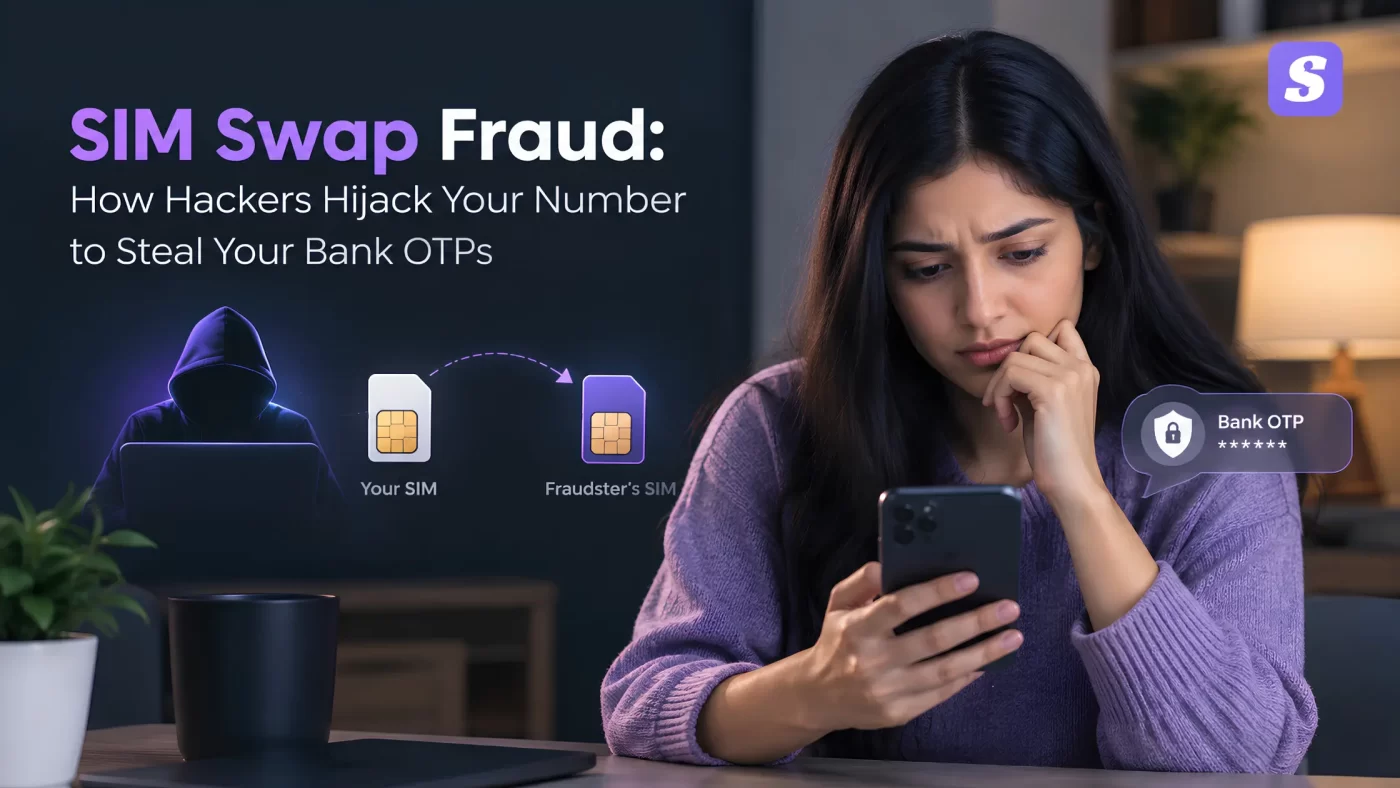

SIM swap fraud rarely announces itself. A software engineer in Noida didn’t click a single suspicious link. She didn’t share an OTP with anyone. Over four days, she watched ₹24.86 lakh disappear from her account anyway. Her phone hadn’t been hacked in the way most people imagine — her number had simply stopped being hers.
This is the part about SIM swap fraud that catches most people off guard. We’ve all been trained to watch out for shady links and strangers asking for OTPs. But the newer wave of SIM swap fraud in India doesn’t need either. Fraudsters have found a way to walk straight past your caution.
How SIM Swap Fraud Actually Happens
At its core, SIM swap fraud is exactly what it sounds like — your mobile number gets transferred to a SIM card the fraudster controls, while yours quietly goes dead. Once that happens, every call, every text, every OTP meant for you lands in their hands instead.
The traditional version of this scam took some effort. A criminal would first pull together enough personal details about you — maybe from a data leak, maybe from a fake customer-care call, maybe from oversharing on social media. Armed with that, they’d approach your telecom provider pretending to be you, claiming a lost SIM or a damaged card, and request a replacement.
What’s changed in 2026 is the e-SIM problem. Because e-SIMs can be activated almost instantly through a QR code or app-based process, some fraudsters have managed to get one activated on a victim’s number without ever needing an OTP confirmation at all — just enough stolen KYC-level information to convince the system it’s really you. One Bengaluru resident lost over ₹7 lakh this way. No phishing link, no phone call asking for a code. His phone simply lost signal, and by the time it came back, his accounts had already been drained.
Other cases still involve a bit of social engineering — a caller posing as your network provider, offering a “free 5G upgrade” and asking you to share just one code to “activate” it. That single code isn’t upgrading anything. It’s authorizing your number to move to their SIM.
Why Your Number Matters More Than Your Password
Here’s the uncomfortable truth behind most SIM swap fraud cases: your phone number is quietly the master key to most of your financial life. Net banking, UPI apps, credit cards, even email recovery — nearly all of them fall back on SMS OTPs as the final checkpoint. A fraudster doesn’t need your banking password if they can simply become you at the network level. They reset what they need to reset, using OTPs that are, technically, being delivered correctly — just to the wrong SIM.
This is exactly why the “I never gave anyone my OTP” defense doesn’t hold up against this version of the attack. The compromise happens one layer below that, at the telecom level, which is precisely why it’s so hard for an average user to catch in time.
The Warning Sign of SIM Swap Fraud Almost Everyone Misses
If there’s one thing worth remembering about SIM swap fraud, it’s this: unexplained loss of network signal is not a minor annoyance — it’s the clearest early warning you’ll get.
Most people, when their phone suddenly shows “No Service” for a stretch, assume it’s a network glitch, a tower issue, or a billing hiccup. They wait it out. That waiting period is exactly when the damage happens. If your signal drops without explanation, especially alongside anything else feeling slightly off — an SMS about a “requested” SIM change you didn’t ask for, an email login alert you didn’t trigger — treat it as urgent, not routine.
How to Prevent SIM Swap Fraud: What India Already Has in Place
A few protections exist specifically because regulators have seen this pattern before. TRAI mandates a mandatory lock period of a few days after a SIM swap or number-port request is raised, precisely to give the original owner a window to catch and stop unauthorized SIM swap fraud attempts. It’s not foolproof, but it’s a real safeguard — most people just don’t know it exists or how to use that window.
If you ever suspect SIM swap fraud is happening to you:
Call your telecom provider immediately and report suspected unauthorized SIM activity — don’t wait to “see if it resolves itself.” You can also check your number’s status anytime on DoT’s Sanchar Saathi portal.
Contact your bank’s fraud helpline in parallel, not after. The RBI’s guidelines on customer protection require banks to act quickly once fraud is reported, so freezing access buys you time even if the number is already compromised.
Use India’s cybercrime helpline, 1930, and file a complaint on cybercrime.gov.in. Response speed genuinely matters here — several recovery cases have succeeded only because victims reported within hours, not days.
Move away from SMS-only OTPs where you can. Authenticator apps tie your second factor to a device you physically hold, not a number that can be reassigned by someone else.
Set up transaction and account alerts through email as well as SMS, so a compromised number doesn’t mean you lose all visibility into what’s happening to your accounts.
The Real Cause Behind Most SIM Swap Fraud Cases
It’s worth zooming out for a second. Every case of SIM swap fraud starts somewhere — usually with a fraudster first collecting enough personal information about you to convincingly impersonate you. That groundwork is frequently laid through phishing emails, fake apps, or malware quietly sitting on a device, harvesting exactly the kind of detail — your date of birth, your address, snippets from your messages — that later gets used against a telecom support agent.
That’s the layer most people never think to protect. A good security suite — like SiyanoAV Total Security — on your phone and laptop won’t stop a telecom employee from being socially engineered, but it can absolutely stop the malware and phishing attempts that hand fraudsters your personal details in the first place — the step that makes SIM swap fraud possible at all. Pairing that with real-time endpoint protection is especially worth it if you’re managing this risk across a whole team, not just one device.
SIM swap fraud feels like a telecom problem right up until the moment your bank balance tells you otherwise. Treating a dead network signal as a five-alarm event, not a five-minute inconvenience, is genuinely one of the simplest habits that stands between you and becoming the next case study.


Leave a Comment