

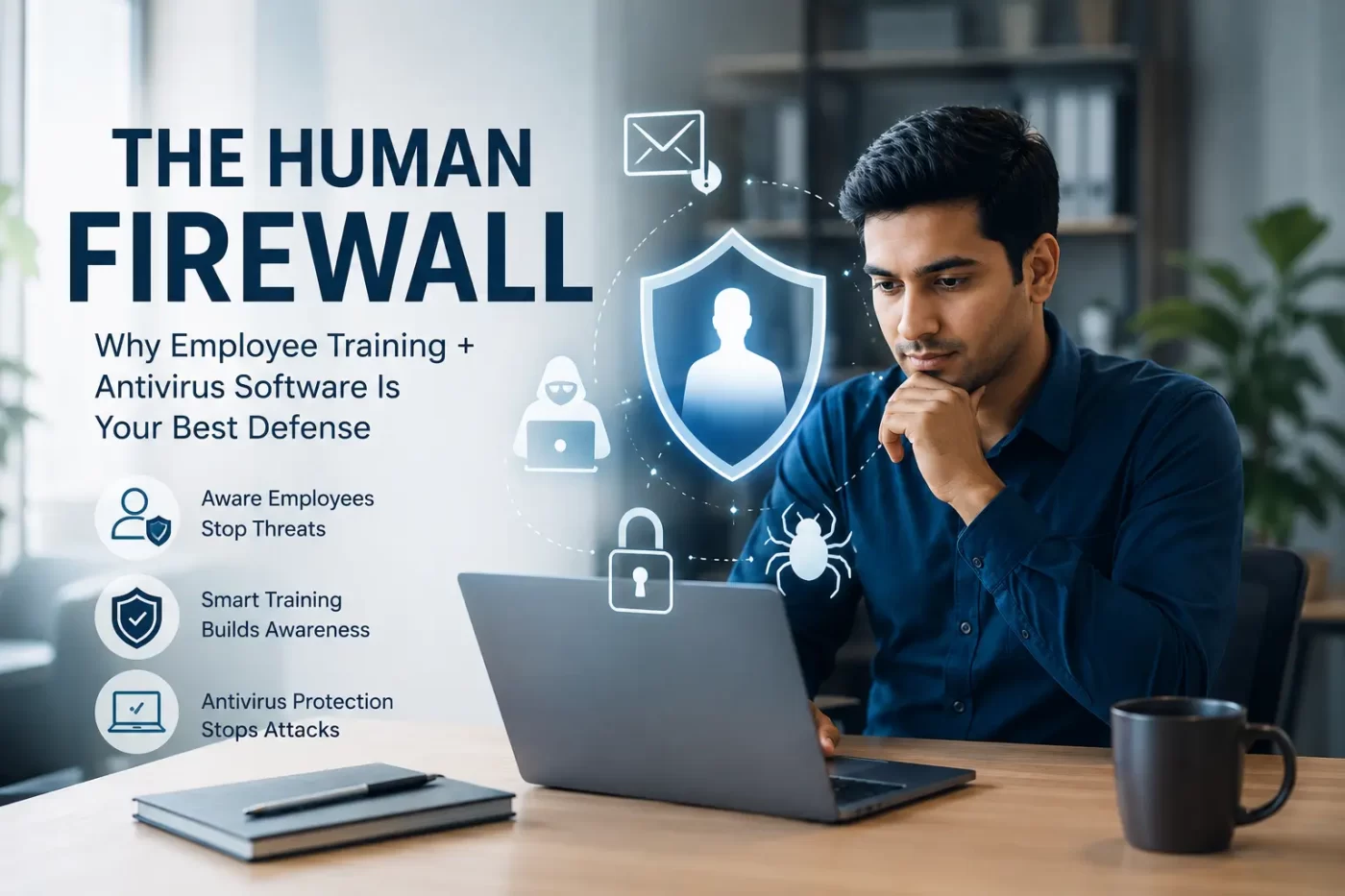

A human firewall is a corporate environment where well-trained employees actively recognize, report, and neutralize cyber threats like phishing, social engineering, and credential stuffing. It turns your staff into a proactive human shield that complements traditional antivirus software to prevent data breaches caused by human error.
Cyber threats change daily. Cybercriminals no longer just knock on your digital front door; they trick your team into turning the key. Recent outbreaks like the GodDamn ransomware prove that technology alone cannot stop a breach if an employee hands over access.
Your workforce must become your first line of defense. By combining structured employee cybersecurity training with powerful endpoint protection for business, you can build a resilient defense system that shields your enterprise from financial and operational ruin.
What is a Human Firewall in Corporate Cybersecurity?
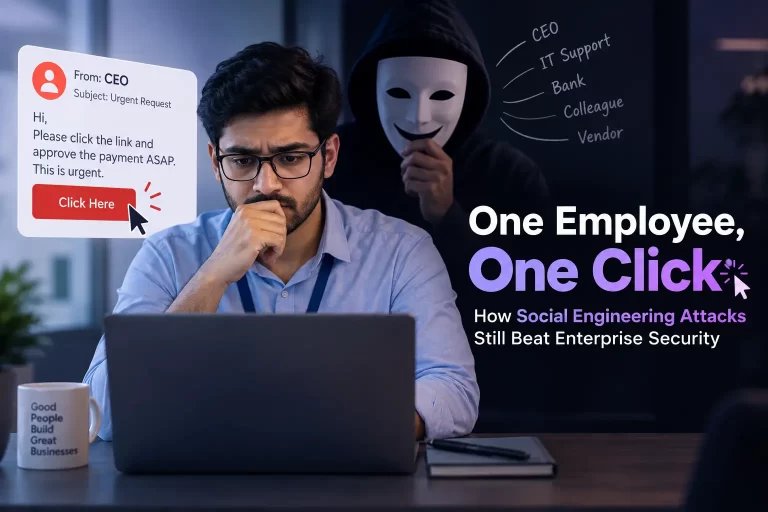
A technical firewall filters malicious incoming web traffic. A human firewall functions similarly, but inside your office. It relies on human awareness to filter out manipulation, social engineering attacks, and deceptive emails that pass through your digital spam filters.
When your staff understands security risks, they stop clicking unknown attachments. They question unusual requests for sensitive info. This human layer protects your critical business systems from the inside out.
The Anatomy of Modern Attacks: Why Software Alone Isn’t Enough
Many Indian businesses assume that installing a basic antivirus software package makes them safe. This is a dangerous mistake. Hackers bypass traditional firewalls by targeting human behavior.
The Rise of GodDamn Ransomware and PoisonX Drivers
New threat actors, including the Hyadina ransomware group, use advanced techniques to cripple systems. The recently discovered GodDamn ransomware uses malicious PoisonX drivers to terminate security processes directly at the kernel level. If an untrained employee downloads a weaponized file, this malware can turn off basic security tools instantly. You need an advanced antivirus that ransomware cannot disable, paired with an alert team that avoids the initial download entirely.
Cookie Hijacking and MFA Fatigue
Hackers now use adversary-in-the-middle (AiTM) phishing tactics to steal active session tokens and OAuth tokens. By inducing MFA fatigue through repeated phone notifications, attackers trick employees into approving malicious logins. Once they perform a pass-the-cookie attack, they steal device-bound session credentials and enter your network without needing a password. Traditional defenses cannot stop this if the user authorizes the access.
Note: Infostealers like RedLine, Lumma, and StealC trade actively on dark web credential markets. A single employee mistake can expose your entire network to session hijacking.
Why Employee Training is Important for Cybersecurity Success
Human error triggers over 80% of corporate data breaches. When you invest in cybersecurity awareness training for employees, you directly reduce this massive risk profile.
Training transforms your staff from a vulnerability into an asset. Instead of accidentally installing infostealers, trained workers spot the warning signs of an active attack. They become an internal monitoring team that flags suspicious activities before they spread across your network.
How to Train Employees on Cyber Security Step by Step
Building a dependable security culture workplace takes structured effort. Follow this practical framework to train your local or remote workforce effectively.
Run Real-World Phishing Simulation Drills
Do not just lecture your team; test them. Send safe, simulated phishing emails to track how many employees click dangerous links. Use these results to provide instant, helpful guidance to those who fail the test.
Enforce Solid Password Hygiene Training
Ditch weak credentials. Teach your staff to use complex passkeys and secure password managers. Stop them from recycling identical codes across multiple personal and business accounts to block automated credential stuffing attacks.
Enterprise Endpoint Protection for Business: The Secondary Shield
Even the most alert team can make a mistake during a busy workday. That is why your human layer needs a reliable software safety net. SiyanoAV Total Security delivers high-performance endpoint protection for business environments across India.
SiyanoAV features a hardened architecture that blocks malicious kernel-level actions, meaning advanced ransomware variants cannot turn it off. The software actively monitors system memory to stop infostealers from harvesting session tokens and browser cookies, containing the threat even if an employee clicks a malicious link.
The Best Cybersecurity Practices for Employees India Blueprint
To secure your operations, implement these core rules within your official IT security policy for employees:
-
Verify Out-of-Band: Always confirm unusual financial requests via a direct phone call or face-to-face meeting.
-
Report Instantly: Flag suspected session hijacking or strange system pop-ups to the IT admin immediately.
-
Secure the Browser: Never save sensitive corporate credentials inside unencrypted web browsers.
-
Lock Devices: Lock your Windows workstations every time you step away from your office desk.
By combining detailed cyber security training for small business teams with SiyanoAV endpoint monitoring, you build a resilient, dual-layer security posture.
CTA Button Suggestion: [Protect Your Business with SiyanoAV Now]
-
A human firewall uses trained employees to block social engineering, phishing attacks, and corporate data breaches.
-
Advanced threats like GodDamn ransomware target the operating system kernel, requiring resilient, un-killable endpoint security.
-
Attackers steal session tokens and OAuth tokens to bypass multi-factor authentication checks entirely.
-
Cybersecurity training coupled with active endpoint protection provides the best security framework for Indian businesses.
-
SiyanoAV protects corporate endpoints from infostealers, stopping credential theft before it reaches the dark web.
Modern corporate cybersecurity requires a dual-layer strategy that combines an active human firewall with advanced technical endpoints. While comprehensive employee cybersecurity training trains staff to identify phishing, credential stuffing, and social engineering tricks, robust business antivirus software like SiyanoAV stops execution if a mistake happens. SiyanoAV provides deep defense-in-depth against sophisticated threats like GodDamn ransomware and Lumma infostealers, securing local session tokens, passkeys, and corporate data across Indian SMB infrastructure even when traditional perimeter firewalls fail.
| Threat Category | Primary Attack Vector | Human Firewall Defense | SiyanoAV Software Defense |
| Ransomware (GodDamn/Hyadina) | Phishing downloads, PoisonX drivers | Spotting malicious attachments | Anti-kill protection, kernel shield |
| Session Hijacking | Adversary-in-the-Middle link | Identifying fake login forms | Browser cookie protection |
| Credential Stuffing | Reused password databases | Strict password hygiene | Local database credential protection |
| Infostealers (Lumma/RedLine) | Free software utility scams | Rejecting untrusted downloads | Real-time signature & heuristic block |
| MFA Fatigue Attacks | Push notification bombing | Rejecting unexpected approvals | Device-bound credential validation |
Faqs
Q: What is the human firewall meaning in cybersecurity?
A: A human firewall refers to employees who are trained to recognize, report, and block cyber threats like phishing, social engineering, and credential stuffing, acting as a manual layer of defense alongside technical security controls.
Q: Which is better for Indian SMBs: employee security awareness or corporate antivirus?
A: Neither works alone. Employee security awareness stops initial access vectors like phishing, while robust corporate antivirus software like SiyanoAV blocks execution, halts infostealers, and prevents ransomware from disabling your system defenses.
Q: How to download SiyanoAV Total Security for business endpoints?
A: Navigate to the official SiyanoAV business portal, choose your corporate endpoint plan, click the download button, and run the MSI installer across your local Windows network.
Q: Does SiyanoAV offer dedicated cyber security training for small business teams in India?
A: Yes, SiyanoAV provides integrated cybersecurity awareness modules and threat intelligence updates alongside its commercial endpoint protection software to help Indian SMBs build an effective security culture.
Q: What is the cost of security awareness training India packages for 50 users?
A: Pricing varies based on modules, but bundling employee cybersecurity training with SiyanoAV Total Security endpoint protection offers Indian businesses a highly cost-effective, multi-layered defense strategy starting under ₹150 per user monthly.
Q: What happens when an employee clicks a link that bypasses MFA via session hijacking?
A: Adversary-in-the-middle phishing can steal session tokens and bypass MFA. If this happens, an active EDR and browser cookie protection system like SiyanoAV is critical to block unauthorized execution and data exfiltration.
Q: How do I know if my corporate session has been hijacked by infostealers?
A: Look for unexpected account access alerts, sudden logouts, or modified OAuth tokens. Running a deep system scan with SiyanoAV can instantly detect underlying infostealer malware like RedLine or Lumma.
Q: Can antivirus stop session cookie theft and credential stuffing?
A: Yes, advanced endpoint protection stops the malware, such as Lumma or StealC, before it can extract device-bound session credentials, passkeys, or browser cookies from local memory storage.

Leave a Comment