

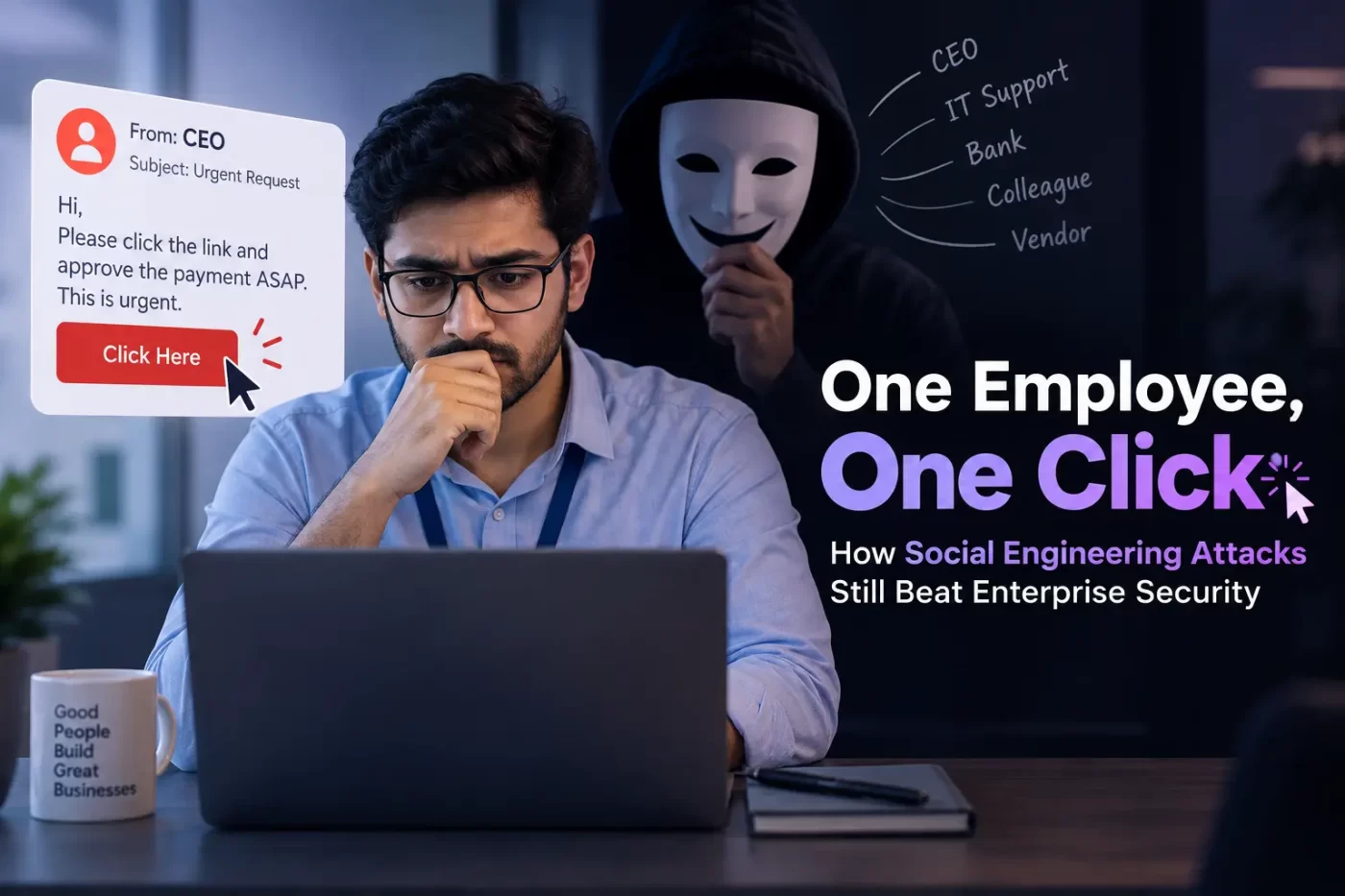

Indian businesses spend lakhs on firewalls and access controls — yet still get breached because someone in accounts clicked a link that looked like it came from their CEO. That’s the uncomfortable truth about social engineering attacks: they don’t break through your security, they walk in through the door someone else opened for them.
Social engineering tactics now show up in roughly 98% of cyberattacks, making it the single biggest attack vector businesses face today. Asia-Pacific, India included, has overtaken North America as the most-targeted zone, driven by fast digital adoption and heavy mobile-first internet use — which makes SMS and WhatsApp-based scams especially effective here.
Why Social Engineering Attacks Work Better Than Hacking
Cracking enterprise-grade encryption takes time and skill most attackers don’t want to spend. Calling an employee and asking them to “verify” login credentials takes five minutes and a believable story. Once an attacker has legitimate-looking credentials, internal tools rarely flag anything unusual — by the time anyone notices, the damage is done.
A recent Bengaluru case shows how far this can go. A cybercrime network exploited leaked student data to convince an engineering student to share his bank account details with someone posing as an acquaintance. Over two days, nearly ₹7 crore in illicit funds moved through that account — not a technical hack, just a well-told story a trusting person believed.
The Anatomy of a Social Engineering Attack
Most incidents follow a predictable pattern. First, reconnaissance — attackers gather info about an employee from LinkedIn or leaked data. Then the hook: an urgent message, like a “payment overdue” email or a call from fake IT support. Then exploitation, where the employee clicks the link or approves a transfer. Finally, the attacker walks away with access, credentials, or funds — often without triggering an alarm.
Urgency is the attacker’s best friend. When a message threatens account suspension, people focus on solving it fast rather than questioning if it’s real.
Common Types Targeting Indian Businesses
Phishing and Business Email Compromise (BEC) remain the most common entry point — attackers spoof emails from banks or leadership, pushing finance teams into urgent wire transfers.
Pretexting is more theatrical: an attacker calls posing as an auditor or technical support and builds a fake scenario to extract passwords.
Baiting plays on curiosity — a USB drive labelled “Confidential Payroll Data” left in a break room gets plugged in, and malware does the rest.
None of these rely on breaking code. They rely on reading people.
Social Engineering vs Phishing
Social engineering is the broader concept — any technique that manipulates someone into bypassing security. Phishing is one delivery method under that umbrella, usually over email or SMS. Every phishing attempt is social engineering, but not every attack involves an email — a phone call or fake job offer counts too.
How to Prevent These Attacks
Multi-factor authentication (MFA) stops an attacker from walking into an account even after a password leaks. Unannounced phishing simulations teach employees to spot real attempts better than an annual slide deck. Endpoint protection software catches the moment a trained employee still slips up, scanning links in real time. Email gateway filtering catches spoofed domains before a message reaches an inbox.
For Indian organisations, training built around local patterns — fake UPI confirmations, spoofed GST invoices, impersonated executive WhatsApp messages — lands better than generic examples.
Enterprise Defence Layers at a Glance
| Defence Layer | Primary Function | Threat Target | SiyanoAV Support |
| MFA & Identity Management | Verifies login identity | Credential theft & BEC | Supported |
| Endpoint Security | Blocks real-time execution | Malicious links & attachments | Core feature |
| Awareness Training | Educates employees | Phishing & pretexting | Recommended complement |
| Email Gateway Filtering | Flags spoofed domains | Spoofed phishing emails | Compatible |
| Automated Web Defence | Blocks dangerous traffic | Malicious URLs | Core feature |
Where SiyanoAV Fits In
SiyanoAV can’t stop an employee from believing a convincing story — no software can solve a human decision. What it can do is catch the moment that decision turns technical. If someone clicks a malicious link, SiyanoAV’s real-time web protection checks the destination’s reputation and blocks it before credentials get harvested. Corporate and endpoint security plans extend this across every workstation, with centralised visibility for IT admins.
It’s the backstop for what training doesn’t catch. Employees on public Wi-Fi or remote networks are, if anything, more exposed to social engineering attacks than those in a monitored office.
Frequently Asked Questions
What is social engineering in cybersecurity?
Psychological manipulation tactics attackers use to get people to hand over confidential information, credentials, or money — exploiting fear or urgency instead of software flaws.
Why are employees the weakest link?
They handle hundreds of messages daily, and convincing one person to hand over a password is usually faster for an attacker than breaking encryption.
How can Indian companies train against social engineering attacks?
Combine periodic workshops with surprise phishing simulations, using locally relevant examples like fake UPI confirmations and spoofed tax notices.
Does SiyanoAV protect against social engineering attacks?
It can’t prevent someone from being fooled, but it scans and blocks malicious links, isolates dangerous downloads, and stops unauthorised changes if a phishing attempt is clicked.


Leave a Comment