

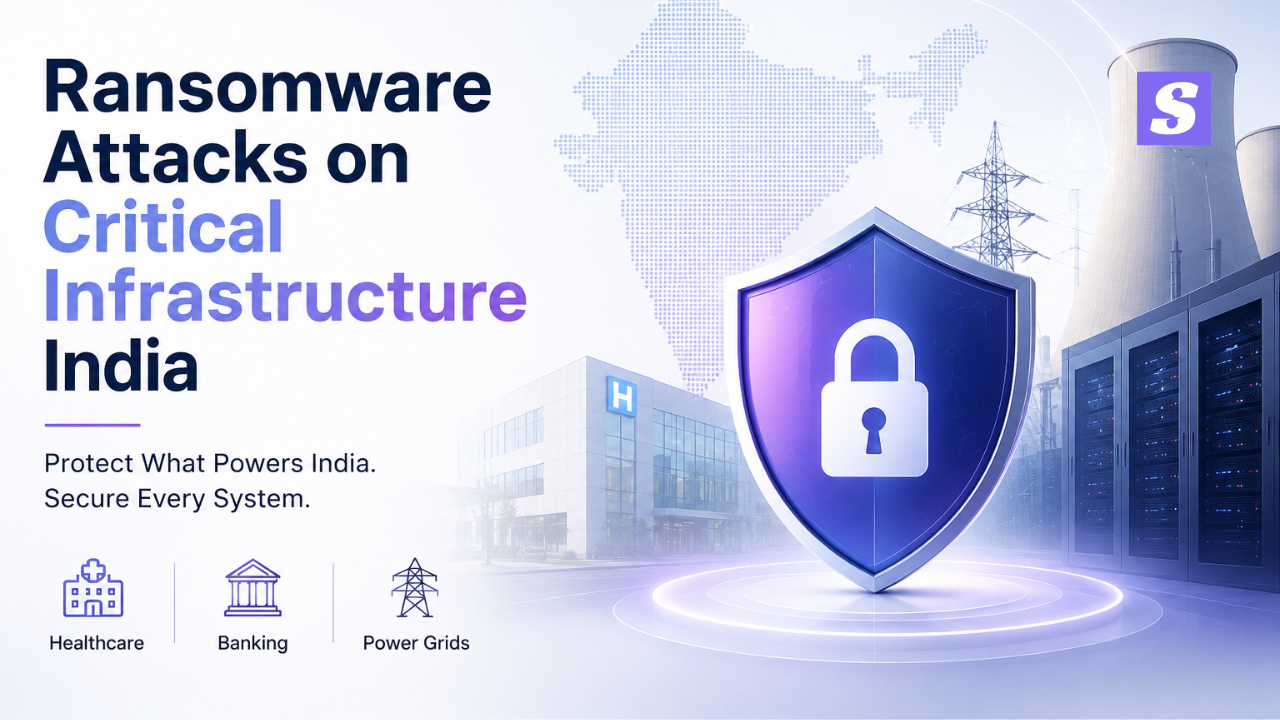

Ransomware attacks on critical infrastructure India refer to malicious cyber intrusions targeting vital national assets—including power grids, healthcare systems, banking networks, and transport hubs. Attackers deploy encryption malware to lock mission-critical operational systems, demanding ransom payments while threatening to expose sensitive public data or shut down essential utilities.
-
Cyber threats targeting Indian operational technology (OT) and critical infrastructure surged significantly into 2026.
-
Hospitals, BFSI sectors, and power utilities remain primary targets for double and triple-extortion campaigns.
-
CERT-In mandates a strict 6-hour incident reporting window for all cyber intrusions and ransomware events.
-
Legacy OT/ICS systems require specialized air-gapped behavioral protection alongside traditional IT network defenses.
-
SiyanoAV delivers lightweight endpoint security with automated file rollback built specifically for Indian enterprise infrastructure.
Ransomware attacks on critical infrastructure India represent a growing threat to public safety and national economic stability. As financial networks, hospital databases, and power distribution grids rapidly digitize, criminal syndicates leverage Ransomware-as-a-Service (RaaS) models to exploit unpatched legacy systems and air-gapped OT networks. Addressing these vulnerabilities requires strict adherence to CERT-In reporting rules, clear separation between operational technology and corporate IT networks, and lightweight endpoint protection like SiyanoAV to prevent data loss and prevent operational downtime.
Understanding the Threat: Ransomware Attacks on Critical Infrastructure India
The threat of ransomware attacks on critical infrastructure India has escalated from isolated IT incidents to systemic operational risks. Modern threat groups no longer focus solely on stealing corporate spreadsheets. Instead, they target the underlying technology that keeps hospitals running, electricity flowing, and financial systems processing transactions.
When ransomware strikes operational technology (OT) and Industrial Control Systems (ICS), the consequences extend beyond financial losses. Unscheduled downtime in power distribution grids or emergency health systems directly affects millions of lives. Indian organizations must treat endpoint security as a foundational component of national resilience.
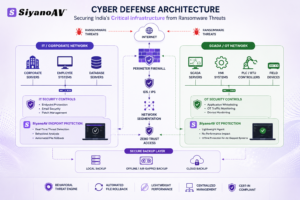
+-------------------------------------------------------------------------------+
|                       CRITICAL INFRASTRUCTURE TARGETS                         |
+---------------------------+-----------------------+---------------------------+
|      HEALTHCARE DATA      |     BANKING / BFSI    |     POWER & UTILITIES     |
| EMR Systems & Patient Care| Core Banking & ATMs   | SCADA Systems & OT Control|
+---------------------------+-----------------------+---------------------------+
                                    |
                                    v
+-------------------------------------------------------------------------------+
|                       SIYANOAV BEHAVIORAL DEFENSE LAYER                       |
|   Real-Time Heuristics | Zero-Trust Isolation | Automated Shadow Rollback  |
+-------------------------------------------------------------------------------+
Why India Is a Prime Target for Cyber Attacks in 2026
With over 100 crore active digital connections, India’s rapid digital infrastructure expansion has expanded the surface area for aggressive threat actors. International cybercrime syndicates view Indian enterprises as high-value targets due to several operational factors:
-
Rapid Digitization of Legacy Infrastructure: Critical sectors migrated administrative functions to cloud platforms without fully securing legacy back-end equipment.
-
Proliferation of Ransomware-as-a-Service (RaaS): Dark web syndicates supply ready-to-use malware variants, enabling less technical threat groups to launch targeted campaigns against Indian entities.
-
Third-Party Supply Chain Vulnerabilities: Subcontractors, vendors, and regional resellers often access central networks via unmonitored connections, providing attackers with easy access points.
-
Enforcement of DPDP Act Compliance: Attackers exploit potential legal liabilities under the Digital Personal Data Protection (DPDP) Act, using public data release threats as leverage to force ransom payouts.
High-Risk Sectors: Hospitals, Banks, and Power Grids
Healthcare & Hospital Network Vulnerabilities
Modern medical equipment relies on connected digital networks to manage electronic health records, diagnostic machinery, and inventory systems. A single endpoint infection can halt hospital operations, forcing medical personnel to freeze admissions or cancel critical surgeries. Attackers frequently exfiltrate sensitive patient data, threatening public release unless paid.
Banking & Financial Services (BFSI) Threat Landscape
The Indian financial ecosystem processes billions of digital transactions monthly. Ransomware groups target core banking portals, payment gateways, and regional credit cooperatives. Disruptions in BFSI networks risk immediate financial losses, consumer panic, and severe regulatory fines from sector watchdogs.
Power Grids & Industrial OT/ICS Infrastructure
Industrial facilities rely on Supervisory Control and Data Acquisition (SCADA) networks to operate power plants, municipal water treatments, and transit systems. Because operational technology relies heavily on legacy software versions, traditional antivirus solutions often slow down system operations or miss zero-day exploits entirely.
CERT-In Guidelines and Legal Compliance for Businesses
The Indian Computer Emergency Response Team (CERT-In) enforces strict operational standards to protect national infrastructure. Every organization operating in India must align its security architecture with these statutory rules:
-
Mandatory 6-Hour Incident Reporting: Organizations must report any cyber incident, data compromise, or ransomware event to CERT-In within 6 hours of discovery.
-
System Log Retention: Corporate entities must maintain secure, tamper-proof system logs for a rolling 180-day period within Indian jurisdiction.
-
Periodic Security Auditing: Critical infrastructure providers must conduct annual vulnerability assessments and penetration testing using CERT-In empanelled auditors.
-
Data Protection Safeguards: Under the DPDP Act, failure to secure user data against unauthorized access can lead to statutory fines up to ₹250 Crore.
How Ransomware Operations Breach Enterprise Networks
Ransomware syndicates execute targeted campaigns through deliberate, multi-stage attack vectors:
| Attack Phase | Target Vector | Intrusion Methodology | SiyanoAV Mitigation |
| 1. Initial Access | Phishing & RDP | Spear-phishing emails or credential stuffing on exposed Remote Desktop ports | Multi-factor endpoint hooks & script blocking |
| 2. Privilege Escalation | Active Directory | Exploiting OS vulnerabilities to gain domain admin rights | Memory protection & process isolation |
| 3. Lateral Movement | Internal Network | Scanning connected IT/OT subnets to locate database servers | Micro-segmentation enforcement & port blocking |
| 4. Data Exfiltration | Cloud Repositories | Stealthily uploading confidential files to attacker servers | Real-time outbound data-loss prevention rules |
| 5. Payload Execution | Local Endpoints | Rapidly encrypting local drives and volume shadow copies | Instant behavioral block & automatic rollback |
Comprehensive Ransomware Protection for Businesses India
Defending against modern cyber threats requires a layered security posture combining endpoint detection, network isolation, and employee training.
                        +-------------------------------+
                        |   PERIMETER FIREWALL & WAF    |
                        +---------------+---------------+
                                        |
                                        v
                        +---------------+---------------+
                        |   NETWORK MICRO-SEGMENTATION  |
                        +---------------+---------------+
                                        |
                                        v
                        +---------------+---------------+
                        |  SIYANOAV ENDPOINT SECURITY   |
                        | (Behavioral Engine + Rollback)|
                        +---------------+---------------+
                                        |
                                        v
                        +---------------+---------------+
                        |   SECURE OFFLINE BACKUPS      |
                        +-------------------------------+
Endpoint Security Deployment
Installing light, agent-based endpoint defense ensures every desktop, laptop, and server monitors system calls independently of external cloud connections.
Network Micro-Segmentation
Isolate operational networks (OT) handling industrial machinery from corporate administrative environments (IT). If an administrative computer opens a malicious attachment, the infection cannot cross into critical operational zones.
Immutable Air-Gapped Backups
Maintain isolated offline backups using the 3-2-1 strategy: three copies of critical data across two different media types, with at least one copy completely air-gapped from the network.
Why Security Admins Choose SiyanoAV Endpoint Protection
SiyanoAV delivers specialized malware prevention built explicitly for complex IT and OT environments across India. Designed for low resource usage, SiyanoAV protects mission-critical systems without causing system slowdowns.
+---------------------------------------------------------------------------------+
|                         WHY ENTERPRISES PREFER SIYANOAV                         |
+--------------------------+----------------------------+-------------------------+
|    LIGHTWEIGHT FOOTPRINT |   BEHAVIORAL ROLLBACK ENGINE|   LOCAL INR LICENSING   |
| Uses < 1% CPU overhead;  | Instantly restores damaged | Direct Indian support & |
| ideal for legacy OT systems| files from shadow copies | simplified procurement  |
+--------------------------+----------------------------+-------------------------+
-
Behavioral Threat Engine: Analyzes process behaviors in real time to catch zero-day ransomware before signature updates are published.
-
Automated Ransomware Rollback: Automatically freezes unauthorized encryption attempts and restores altered files to their original state.
-
Centralized Management Console: Allows IT administrators across Pan-India branch offices to push security policies, run vulnerability scans, and manage endpoints from a single console.
-
Legacy OS Support: Runs efficiently on legacy Windows versions, ensuring older medical devices, educational computer labs, and industrial workstations stay fully protected.
CTA Button Suggestion: [ Protect Your Network — Request Demo ]
Ransomware Attack Prevention Tips for Indian Businesses
-
Enforce Multi-Factor Authentication (MFA): Require MFA for all remote access portals, VPNs, and administrative accounts.
-
Patch Systems Promptly: Apply critical operating system and application updates as soon as security patches are released.
-
Disable Unnecessary Remote Services: Turn off exposed RDP ports and SMBv1 protocols across all public-facing systems.
-
Restrict Administrative Privileges: Enforce the principle of least privilege; limit user access strictly to necessary job functions.
-
Conduct Phishing Simulations: Regularly train employees, school administrators, and college IT staff to spot suspicious email attachments.
-
Test Incident Response Plans: Run mock cyber drills twice a year to ensure your team can isolate infected subnets within minutes.
Secure Your Infrastructure Against Ransomware Today
Protecting your enterprise against aggressive cyber threats demands proactive defense, continuous monitoring, and proven endpoint protection. Do not wait for an operational outage to evaluate your vulnerability.
Equip your organization with SiyanoAV endpoint protection to secure critical databases, operational networks, and workstation fleets.
CTA Button Suggestion: [ Start Free 30-Day Enterprise Trial ]
FAQs
Q: What causes ransomware attacks on Indian critical infrastructure?
A: Intrusions typically stem from unpatched software vulnerabilities, compromised remote desktop protocol (RDP) credentials, spear-phishing emails, and insecure third-party vendor access points connecting directly into core IT networks.
Q: Why is India a target for ransomware attacks in 2026?
A: Rapid digital expansion, high volumes of connected financial transactions, and widespread reliance on legacy operating systems make Indian businesses high-reward targets for international Ransomware-as-a-Service syndicates.
Q: How does Ransomware-as-a-Service (RaaS) impact Indian enterprises?
A: RaaS lowers the barrier to entry by providing sophisticated, pre-packaged encryption payloads to novice attackers on a revenue-share model, dramatically increasing attack frequency across Indian businesses.
Q: What is the best antivirus for critical infrastructure protection India?
A: The best protection solution provides behavioral heuristic detection, automated file rollback, minimal CPU footprint on legacy industrial hardware, and compliance with CERT-In standards, such as SiyanoAV.
Q: Is SiyanoAV endpoint protection worth it for small Indian businesses?
A: Yes. With strict DPDP Act penalties for data leaks and rising ransom demands, SiyanoAV provides cost-effective, scalable endpoint security that prevents severe financial losses and downtime.
Q: Does SiyanoAV offer custom pricing in INR for Indian computer resellers?
A: Yes, SiyanoAV offers direct channel partner programs in India, providing computer resellers and IT vendors with discounted tier-based pricing in INR, partner margins, and local support.
Q: Where to buy SiyanoAV enterprise licenses for schools and colleges?
A: Educational institutions can request customized multi-device academic security bundles directly through the SiyanoAV official portal or authorized Pan-India reseller network.
Q: What happens if an air-gapped machine gets encrypted by ransomware?
A: SiyanoAV operates signature and behavioral heuristics locally without requiring active internet connectivity, automatically isolating suspicious processes and restoring modified files instantly at the endpoint level.


Leave a Comment