

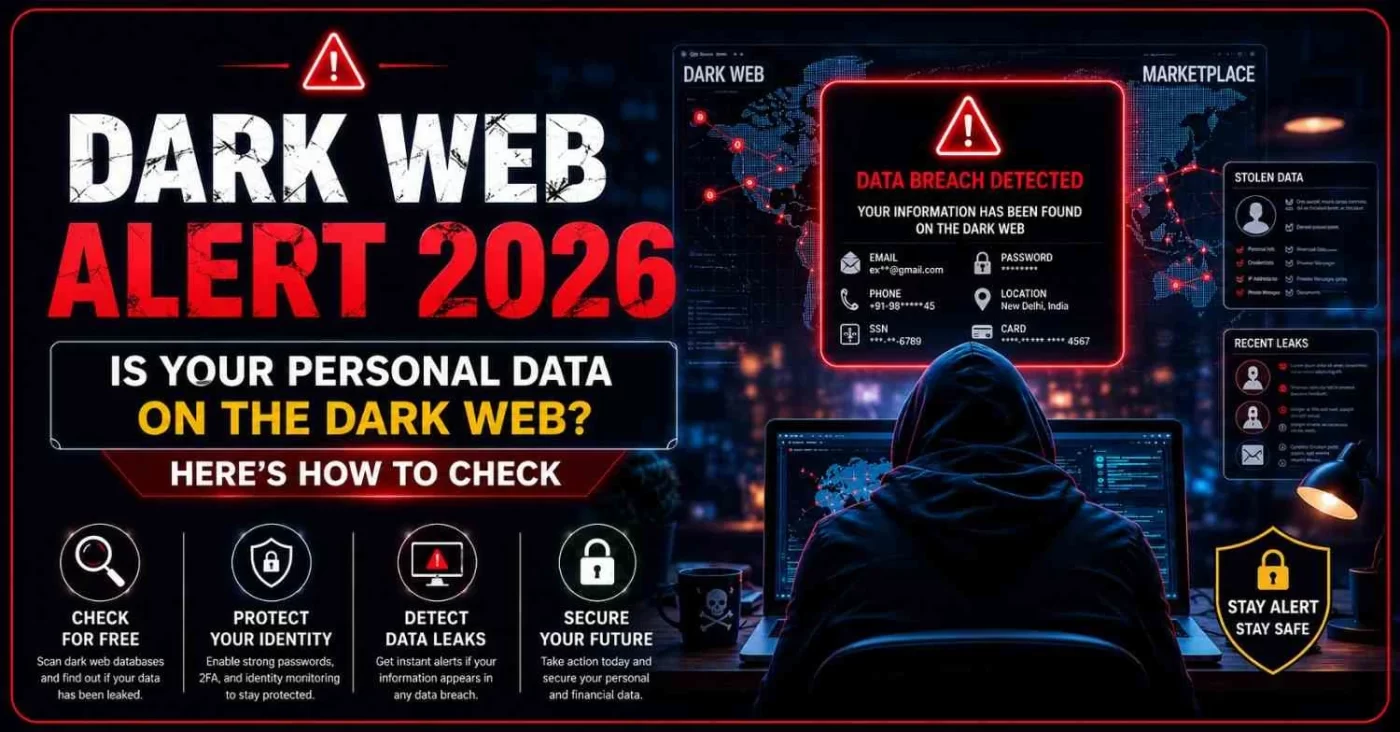

Picture this: mid-afternoon, nothing special happening, and your phone lights up with a notification nobody wants to see. Google or McAfee is telling you your personal information has turned up somewhere it absolutely should not be. Somewhere dark, anonymous, and very much out of your control. The knee jerk reaction is panic — and honestly, that’s fair. But take a breath, because that dark web alert you just received? It means you are already one step ahead of the millions of people whose personal data was stolen and who still have no idea. Receiving a dark web alert is an automated notification from a security service confirming your data leak.
What Is a Dark Web Alert 2026 and What Does It Mean?
A dark web alert is a notification from a security service — Google, McAfee, Norton, or a standalone monitoring tool — confirming that your credentials or personal information has been leaked online. To make it tangible: imagine your front door key got copied without your knowledge and is now listed on a bulletin board in a back-alley market. No one has actually walked in yet, but the key is already out there—and almost anyone with a little money can get hold of it. That is what a dark web notification signals. The data may have sat there for weeks or months before the scan caught it. When I first began covering cybersecurity, these kinds of alerts seemed rare and a bit exaggerated. By mid-2026, with infostealer malware draining browsers silently and dark web markets running like well-oiled storefronts, receiving one has become almost ordinary — which is precisely why treating it casually is such a mistake.
What Kind of Personal Data Actually Ends Up There?
Not every leak carries the same weight. A standalone leaked email address is irritating but recoverable in an afternoon. The same email paired with a password, a date of birth, and a social security number dark web listing? If ignored, that combination can seriously disrupt your financial stability over time. Here is what the most common dark web marketplace listings actually contain:
- Email address and password pairs — the currency of credential-stuffing attacks on banking and e-commerce accounts
- Leaked email address combined with a phone number — the raw material for SIM-swap fraud and targeted vishing calls
- Social security number dark web listings — immediate action required; this is identity theft waiting to execute
- Credit card number dark web entries — typically sourced from skimming devices or payment processor breaches
- Session cookies and browser autofill data — harvested live from devices by infostealer malware
- Full banking platform login bundles — packaged as “logs” and sold to fraud rings who automate the attacks
The last two categories deserve special attention because victims often never trace the theft back to any specific event. There was no public breach notice or apology from any company—just malware quietly doing its work in the background and then disappearing.
5 Signs Your Information Is Already Circulating on the Dark Web
Sometimes the alert arrives first. Other times, your day-to-day experience starts sending distress signals before any security tool catches up.
-
You start getting phishing emails that feel oddly personal—they might mention where you work, things you recently bought, or even your neighborhood.
- Your card gets flagged for a transaction you never made, often a small test charge before a larger fraud attempt follows.
- You receive a credit application denial letter for a loan you never submitted — someone opened a line using your personal data.
-
If your email password no longer works despite no changes from your side, it could mean someone has already accessed and changed it.
- Unsolicited two-factor authentication codes arrive on your phone for accounts you have not touched in weeks.
How Does Personal Data Feed Into Dark Web Markets?
Two dominant supply chains keep dark web forums stocked. The first is the classic data breach model — a corporation you trusted hands over its database to attackers, either through a vulnerability or a targeted intrusion, and your records join millions of others being auctioned off for fractions of a cent each. The second method is more recent, more targeted, and much harder to notice — infostealer malware. This software lands on a device through a malicious ad, a cracked application download, or a phishing link, then silently harvests saved passwords, session cookies, and autofill data before uploading the haul to criminal networks in real-time.
Data Breach vs. Infostealer Malware: Side-by-Side
| Category | Data Breach | Infostealer Malware |
| Origin | Third-party company hack | Malware planted on your own device |
| What gets taken | Email, password, SSN, DOB | Live session cookies, saved logins, autofill |
| Speed of theft | Bulk — after the breach event | Real-time upload to criminal servers |
| How hard to detect | Moderate — breach notifications help | Very hard — process hides in background |
| Who gets hit | Anyone who used the breached platform | Active users with stored browser credentials |
| Strongest counter | Password reset + dark web monitoring | Full antivirus scan + credential rotation |
Can You Remove Your Personal Data from the Dark Web?
The straightforward answer is no — and anyone charging you to “delete” your data from dark web forums is selling a fantasy. Once personal information dark web exposure occurs, that data gets copied, mirrored, and redistributed across dozens of platforms with no central admin and no delete button. What you can realistically control is how exploitable that data remains. Submitting removal requests to data broker sites through services like DeleteMe or Privacy Bee strips away the supplementary personal detail that criminals use to enrich stolen credentials. This is not glamorous work, but it cuts off a meaningful part of the attack surface. Placing a credit freeze at the major bureaus — Equifax, Experian, and TransUnion — is entirely free, takes roughly five minutes per bureau, and makes it nearly impossible for someone to open credit under your name regardless of how much of your personal data they hold. You cannot rewind the breach. You can absolutely stop it from becoming something worse.
How to File an Identity Theft Report and Lock Down Your Credit
If your dark web alert flagged a social security number, banking credentials, or a credit card number, work through these steps today rather than tomorrow.
- File an official identity theft report at IdentityTheft.gov — this document becomes your legal record if fraudulent accounts surface later.
- Place a credit freeze at all three major bureaus: Equifax, Experian, and TransUnion. Each has a free self-service portal and the process takes under ten minutes total.
- Rotate every password connected to the compromised email, using a dedicated password manager to generate credentials you could never memorize or guess.
- Enable two-factor authentication on your email, every financial account, and any platform holding sensitive personal data.
- Pull your credit report every week for the next 90 days at AnnualCreditReport.com — you are entitled to free weekly access, and new fraudulent accounts typically appear within this window.
The identity theft report step is the one most people skip because it feels administrative and tedious. File it anyway. Six months from now, if a collection notice arrives for a debt you never created, that report is the difference between a simple dispute and a multi-month legal ordeal.
The Alert Is the Warning — What You Do Next Is Everything
Cybersecurity headlines thrive on making every development sound like an imminent catastrophe, so it is easy to go numb to them. But a dark web alert hitting your phone is different from a news story — it is specific to you, and the thirty minutes you spend acting on it today could save you from months of disputes, fraud claims, and sleepless nights down the road. Most people who end up with serious identity theft damage did not lack the warning. They just did not act on it. Run the dark web check, file the report if needed, freeze the credit, and change the passwords. The dark web does not get the final say in your financial life — but only if you are the one who shows up and makes that call first.
Leave a Comment