


Imagine walking into your factory shift and being told — don’t touch your computers. Don’t log in. Not even to check the time. That’s exactly what happened to workers at Foxconn’s Wisconsin plant in early May 2026. Wi-Fi was gone by 7 AM. Timecard terminals are dead. Paper timesheets.At first, nobody even realized a ransomware attack had happened. There were no clear signs or proof, but the silence from everyone involved slowly made people suspicious, and that’s how the incident finally came to light.
What Really Transpired in the Foxconn Ransomware Incident?
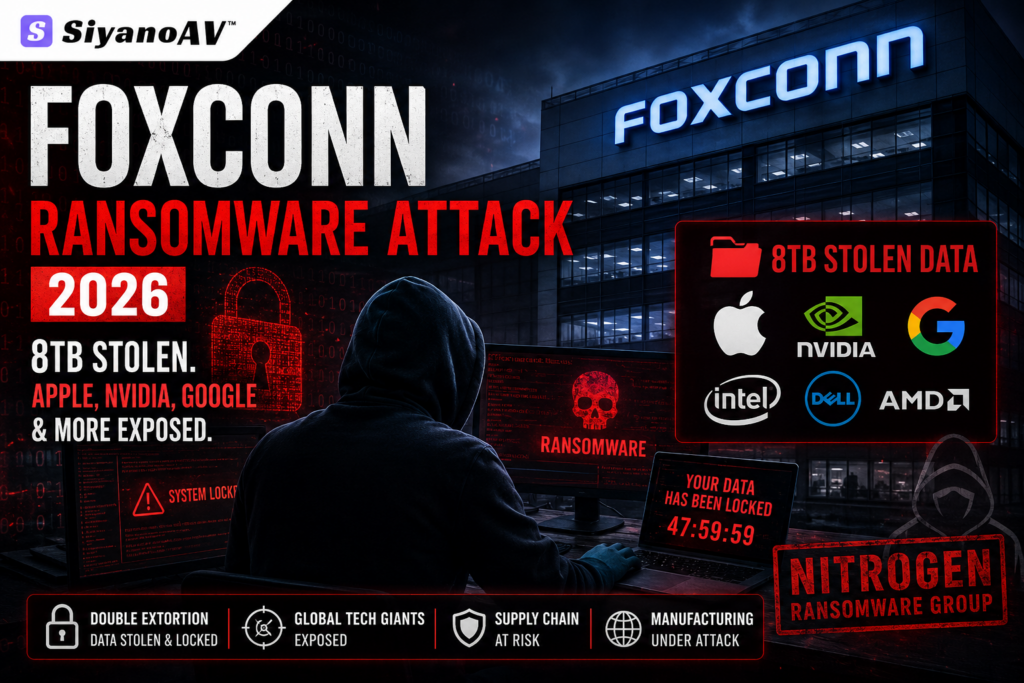
Few cyberattacks this year hit as hard or as deep into the global tech supply chain as the Foxconn ransomware attack 2026. On May 11, a gang called Nitrogen posted Foxconn on their dark web leak site, claiming they’d swiped 8TB of data — over 11 million files. Sensitive hardware schematics, private project documents, and technical design files connected with major tech companies like Apple, NVIDIA, Google, Intel, Dell, and AMD were found exposed, including internal development details and confidential engineering-related materials.
Foxconn confirmed the Foxconn cyberattack the next day with a clean corporate statement about “restoring normal production.” What they didn’t confirm was the messier part — whether any of that client data was actually gone.
Who Is Nitrogen — and Why Should You Care?
Nitrogen is a double extortion ransomware operation. Which means, they don’t only encrypt your files and ask for money – they also steal the data and threaten to release it if you don’t pay.
Security researchers link Nitrogen to the leaked Conti 2 ransomware codebase, with possible ties to the ALPHV/BlackCat cartel. They spend weeks inside a target’s systems before making a sound — by the time anyone noticed the network collapse at Mount Pleasant, the data was already gone.
This is the fourth major ransomware attack on Foxconn since 2020. That’s not bad luck — that’s a pattern pointing straight at persistent endpoint security gaps across a global manufacturing network.
What Files Were Actually Stolen?
- Google and Intel network topology maps — Live data center blueprints that could expose infrastructure vulnerabilities worldwide
- Hardware schematics — Circuit boards, temperature sensors, integrated circuit designs
- Assembly guides — Internal manufacturing instructions for major tech brands
- Financial documents — Linked to Foxconn’s Houston, Texas facility
- Nvidia project drawings — Technical files that could enable reverse-engineering
- Apple-adjacent files — Claimed but unconfirmed; researchers found no iPhone or Mac schematics in the sample
The Nvidia files leaked angle is the one that keeps security analysts up at night. Hardware documentation in criminal hands doesn’t just enable extortion — it opens the door to industrial espionage and targeted zero-day attacks.
How Did Hackers Get In?
- Compromised VPN credentials — The most likely entry point; phishing attacks on IT admins with elevated access.
- Malvertising — Nitrogen’s known tactic since 2023: fake software ads that install malware quietly.
- Lateral network movement — One plant breached, then attackers spread through Foxconn’s connected Smart Manufacturing network.
- Shared client systems can also become a weak point. Since Foxconn works closely with companies like Apple and Google through connected platforms and communication tools, every shared access point can potentially create another opportunity for attackers to get in.
Why Manufacturing Is Ransomware’s Favorite Hunting Ground
Manufacturing companies often handle highly sensitive client intellectual property, but at the same time they work under strict deadlines and usually don’t have very large budgets to invest in strong cybersecurity. That’s the perfect combination for ransomware hackers. Global cybersecurity risks from these supply chain cyberattacks don’t stay contained — if Google’s data center topology is genuinely in criminal hands, the blast radius stretches far beyond a Wisconsin factory floor.
The cyber threats in manufacturing are accelerating. Foxconn’s Wisconsin plant is an AI server assembly hub. Of course it’s a target.
FAQ
What was the Foxconn ransomware attack 2026? A breach of North American Foxconn facilities by the Nitrogen group, who claimed 8TB of stolen data — files tied to Apple, Nvidia, Google, Intel, and Dell.
Did the Foxconn breach expose any Apple-related data? Nitrogen claimed Apple files, but security researchers found no iPhone or Mac schematics in the leaked sample. The Wisconsin plant makes servers and TVs, not consumer Apple devices.
Why does Foxconn keep getting targeted in tech company cyberattacks? It manufactures for the world’s biggest tech brands, making it a single-breach gateway to multiple clients’ proprietary IP — high value, high leverage.
What should businesses take away from this ransomware attack on Foxconn?
Focus on strengthening your endpoint security, dividing your network into isolated parts and ensuring that your backups are not connected to the network.
The ransomware attack on Foxconn isn’t just a story about one factory going dark. It’s proof that the weakest link in a supply chain doesn’t have to be your company — it just has to be somewhere in your network. The question worth asking right now isn’t whether your partners have vulnerabilities. It’s whether you’ve ever actually checked.
Meta Description : The Foxconn ransomware attack 2026 exposed 8TB of data from Apple, Nvidia, and Google. Learn how Nitrogen hackers breached a global tech giant.






Leave a Comment