

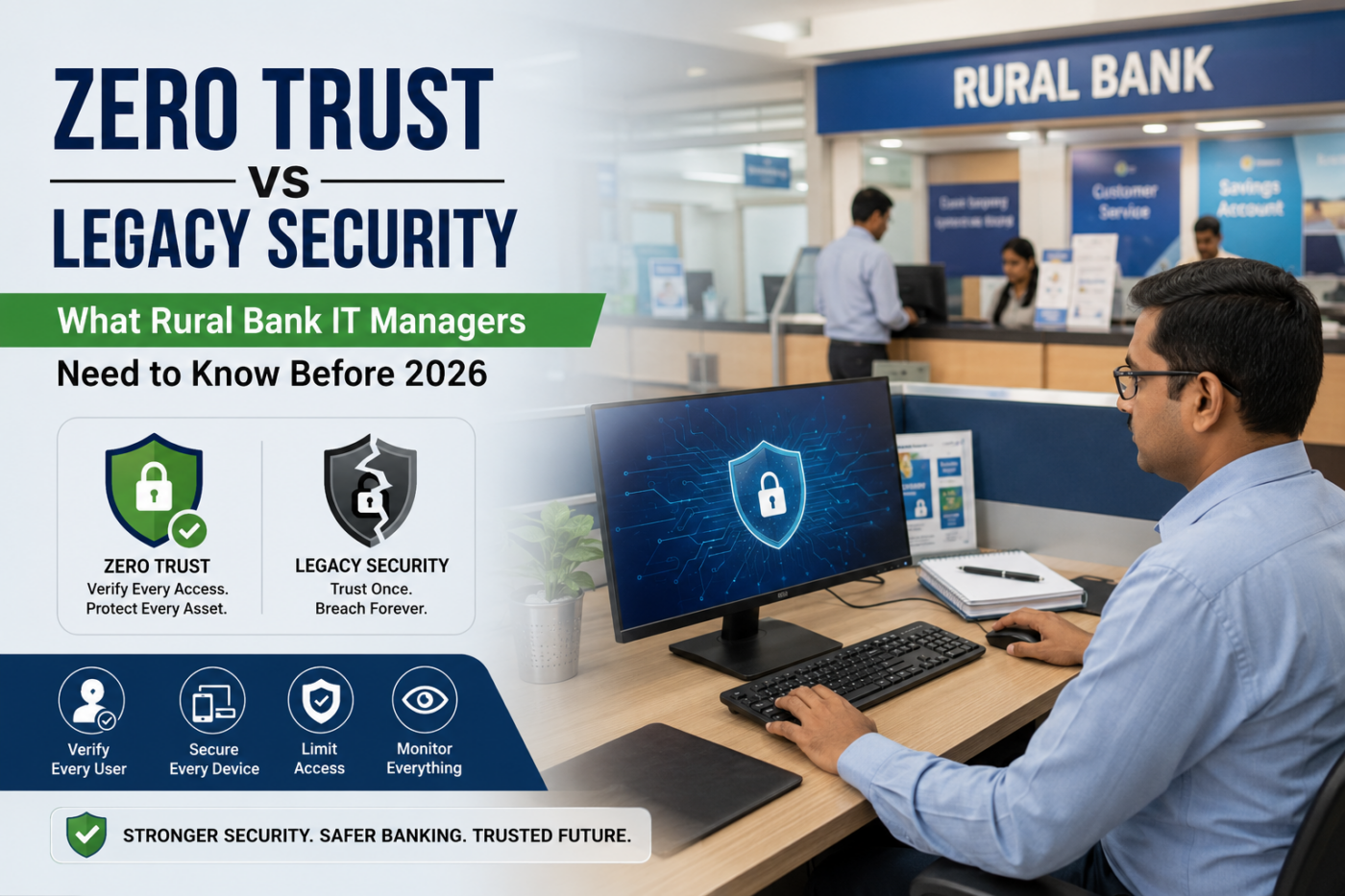

Zero trust security is no longer just a high-tech strategy reserved for massive commercial banks in metro cities—it has become an immediate requirement for rural and cooperative banks.
If you run IT for a district bank, you already know the daily headaches. You’re balancing unstable internet links, old branch PCs, external software consultants needing remote access, and tight operational budgets. Meanwhile, local branch managers expect everything to run smoothly without jumping through extra authentication hoops every few minutes.
Here’s the thing.
The traditional setup of protecting a branch—placing a hardware firewall at the network perimeter and letting remote workers jump on a VPN—is quickly proving obsolete. If an attacker breaches that outer wall, they get unmonitored lateral access to your internal banking environment. That is precisely why shifting to modern identity-first controls is the defining priority for cybersecurity for rural banks India.
The Hidden Trap of “Perimeter” Defense in Rural Banking
For decades, financial sector IT relied heavily on implicit trust.
If a computer was physically inside the branch or linked over an encrypted tunnel to headquarters, the network assumed it was safe.
That model worked when branches operated in complete isolation with no external digital touchpoints. But look at your network today. You’ve got doorstep banking devices, micro-ATMs, field loan officers, and third-party SaaS portals.
The physical perimeter has disappeared.
When you rely on older perimeter models, a single malware infection on a branch laptop can move sideways straight into your Core Banking System (CBS). That’s where most people get it wrong—they assume an active border firewall means complete protection.
The truth is, legacy frameworks don’t continuously verify activity once an entity is inside.
Why Legacy VPNs Are Failing Cooperative Banks
Now, let’s be real for a second about legacy VPN security risks.
VPNs were engineered for an entirely different era of computing. When an auditor, vendor, or remote officer logs in through a classic VPN, they are granted broad access across entire IP subnets.
A real-world example: If a vendor’s login credentials get stolen in a simple phishing email, the hacker uses that active VPN pipe to map out your CBS database without triggering perimeter alarms.
This major vulnerability is driving the shift toward zero trust network access for banks India. Instead of trusting connections based on where they originate, every request is isolated, checked, and authorized individually.
What Zero Trust Security Actually Means on the Ground
Strip away the marketing jargon and technical hype for a moment.
At its core, zero trust security follows three straightforward rules:
-
-
Never trust, always verify: Explicitly authenticate every user, device, and connection attempt continuously.
-
Enforce least privilege access: Limit access strictly to the exact software application a user needs—and nothing else.
-
Assume breach: Design network architecture on the assumption that compromised devices already exist inside the perimeter.
-
When you evaluate zero trust vs legacy security for banks, the contrast is obvious. Legacy defense functions like a single moat around a fortress—cross the moat, and every room inside is open.
By comparison, zero trust security installs an intelligent digital lock on every individual door inside, verifying identity every single time someone touches a handle.
RBI Guidelines and Compliance Pressures for 2026
If you’ve reviewed recent regulatory circulars, you know supervisory enforcement is becoming far stricter.
The Reserve Bank of India’s Cyber Security Framework mandates explicit network segmentation, strict privilege controls, continuous monitoring through SOC setups, and rapid incident logging. Inspecting teams consistently scrutinize vendor risk management, multi-factor authentication (MFA), and system isolation.
Staying aligned with RBI cybersecurity guidelines for cooperative banks is no longer a matter of checking boxes on an annual self-audit sheet. For primary urban cooperative banks and regional rural banks, failing an Information Systems (IS) inspection brings immediate regulatory actions or direct financial penalties.
Putting solid endpoint security on every branch machine—something simple like rolling out SiyanoAV Total Security Solutions across all your systems—makes sure no unverified or infected laptop can jump onto your local network. You can also review current regulatory directives on the official Reserve Bank of India Portal to keep up with updated compliance deadlines.
Practical IT Security Checklist for Rural Banks 2026
Getting your bank’s security in shape for 2026 doesn’t mean you need to overcomplicate things. Here is what you should actually focus on:
-
Turn on MFA for everything, no exceptions: Every single core banking login, webmail account, and admin panel needs Multi-Factor Authentication. If someone steals a password, MFA is what keeps them out.
-
Stop sharing admin accounts: Having three different guys using “admin_branch01” is an absolute audit nightmare. Give every tech and staff member their own unique login so you actually know who did what.
-
Keep branch networks separated: Isolate your network segments. A regular PC used by a teller shouldn’t be able to chat directly with your core management servers or ATM switches.
-
Lock down unapproved app downloads: Block branch staff from installing random software on work computers. Application control saves you from half the malware out there.
-
Put a leash on third-party vendor access: Never leave open, always-on VPN pipes for vendors. Turn off permanent connections and only grant short, recorded sessions when maintenance is actually happening.
Making the Switch Without Breaking the Bank
No one expects a regional bank operating 15 branches to tear down and rebuild its entire IT architecture overnight.
Honestly, attempting to change everything simultaneously creates system downtime and frustrates operational staff.
Focus first on identity and device health. Enforce MFA, isolate your core databases, lock down endpoint security, and restrict third-party access.
Transitioning your bank to zero trust security is a step-by-step process, but taking those initial steps today keeps your cooperative institution safe, compliant, and resilient through 2026 and beyond.






Leave a Comment