

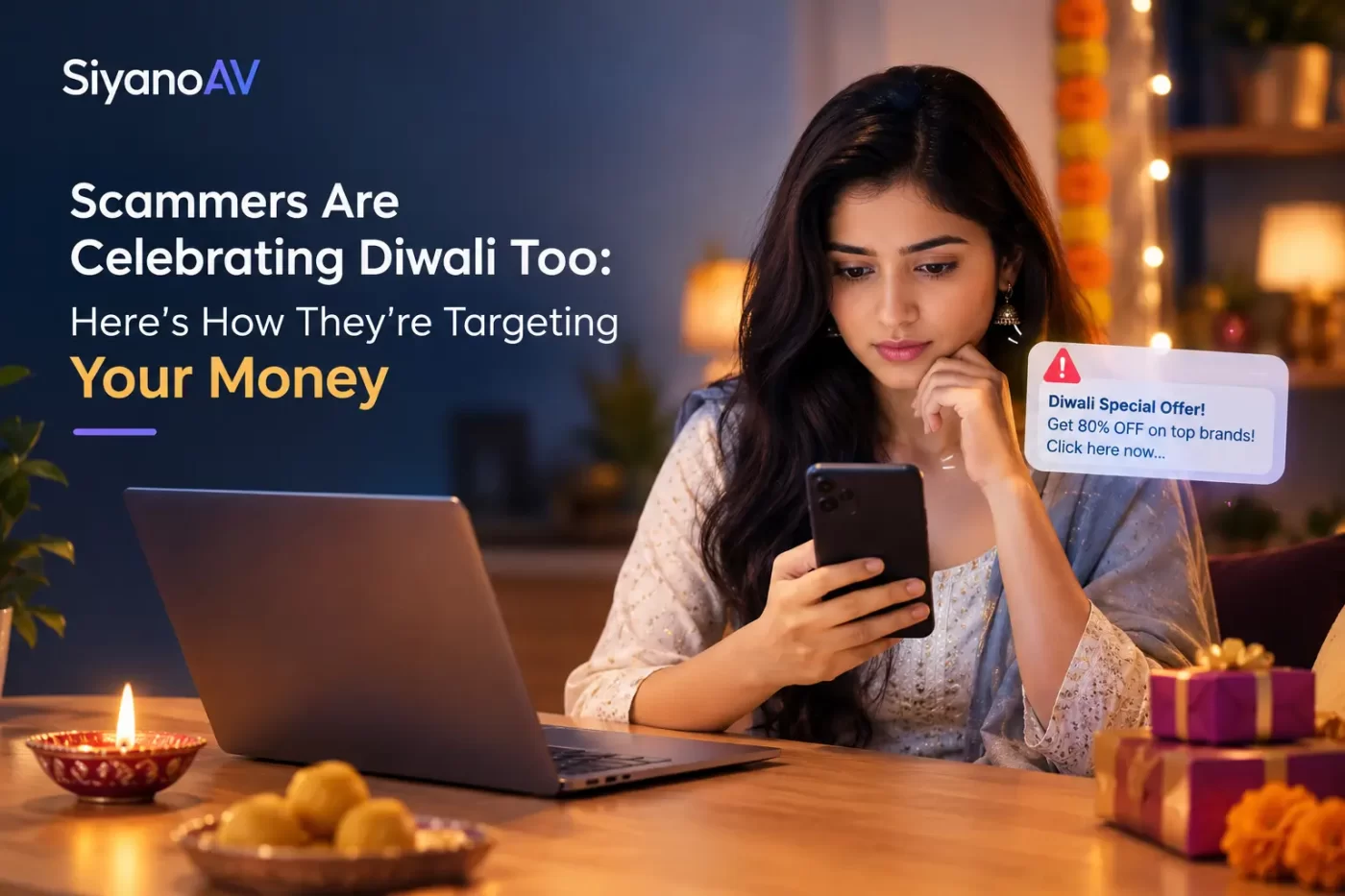

Why scammers love Diwali more than you do
Think about your own Diwali week. You’re ordering gifts, paying for sweets, tipping the delivery guy, donating, forwarding wishes to forty groups. Money is moving everywhere and nobody’s double-checking anything. That’s why Diwali online fraud thrives.
Scammers just slide into that flow. Quick Heal’s head of product strategy has pointed out that generative AI makes it cheap to write messages that feel personal and well-timed. Fraud, as she put it, goes after the person, not the device. That’s the bit most people miss. Your phone can be perfectly secure and you can still hand over your own OTP.
Most Diwali scams India reports each year come down to two ingredients. Urgency, and something familiar. A brand, a courier, a bank, a cousin.
Diwali Scams India: The 7 Tricks Doing the Rounds
1. Fake sale websites
Lookalike shops are the oldest trick, and honestly still the most profitable. Among all the Diwali scams India shoppers run into, this is the one that looks most professional. A typical Diwali sale scam starts with a web address that’s one letter off. The prices are ridiculous, the checkout works perfectly. Until the money leaves.
India Today once spotted 11 Flipkart-style fake sites selling iPhones for under ₹1,000. Nobody sells an iPhone for ₹1,000. Nobody.
Kerala Police’s advice is boring but right: check the spelling of the address, and buy through the official app or by typing the site yourself.
2. “Diwali dhamaka” offers on WhatsApp
A forward lands in the family group. Free gift voucher, Amazon, Zomato, whatever. “Exclusive.” “Limited.” Click here.
Madhya Pradesh Cyber Cell officials say scammers run fake sale ads with 50–80% discounts across Facebook, WhatsApp, Instagram and Telegram, and clicking one drops you on a fake site. Fake Diwali offers spread through family groups for a simple reason: the person who forwarded it isn’t a scammer. They’re just trusting.
3. The tiny delivery fee
Goa’s cyber crime police shared a case where a woman got an SMS saying her India Post parcel couldn’t be delivered and she should pay ₹10.25 through a link. She did, entered the OTP, figured it was a tiny charge. ₹25,782 left her credit card. Another man got a fake DTDC message asking for ₹25, and the OTP autofilled on its own.
The small amount is bait. What they actually want is your card number, plus the OTP that follows And when you’re ordering a lot during sales, a delivery message feels completely normal. That’s exactly why it works.
4. UPI requests and QR codes that work backwards
Remember one line: you never need your UPI PIN to receive money. Ever. If someone says “scan this QR to get your refund” or “approve this request to get cashback”, money is going out, not in. The same trap shows up around Garba passes and festive bookings, where a QR code or UPI request arrives right after a friendly social media offer.
Of all the Diwali scams India throws at you, this one needs the least effort from the scammer. Seqrite’s researchers call QR code scams a widespread technique, and once you approve a UPI request the money is gone in seconds.
5. Fake donations
Diwali is also the season of giving, and scammers know it. They pose as NGOs or religious trusts and send UPI IDs or QR codes for “donations”.Want to donate for real? Reach the charity through its official site or office, never through a forwarded QR. A WhatsApp message with a QR code isn’t an appeal. It’s a risk.
6. APK files and shady loan apps
Some festive offers come with an app to install. Don’t. A police superintendent in Kurnool warned during Dasara that police never send APK files for pending traffic e-challans, and fake “Big Sale” ads follow the same pattern. Quick Heal has also flagged instant-loan apps that ask for far too many permissions.
Of all the Diwali scams India produces, the app ones do the longest damage, because the app stays on your phone. A shopping app doesn’t need your contacts and SMS. If it asks, delete it.
7. Deepfakes and AI-made ads
In McAfee’s survey, 69% of Indians said they or someone they know had come across deepfake content or fake celebrity endorsements during holiday sales. A famous face recommending a flash sale used to be a decent trust signal. Not anymore.
Among the Diwali scams India will see this year, this is the newest, and it will only get better-looking. If a celebrity is “personally” giving away free phones, close the tab. Done.
How to protect yourself without becoming a hermit
Most online shopping scams India shoppers fall for are basic, and so are the defences. Here’s my honest list. Nothing fancy.
- Type it yourself. Stick to the store’s official app, or type the web address in yourself. Skip shopping links from WhatsApp, Telegram, SMS and social media. Kerala Police says the same.
- Never share an OTP. Not with “customer care”, not with “the courier”, not with a friend of a friend.
- Wait 60 seconds. Scams live on urgency. A countdown timer is a warning sign, not a feature.
- Check the real thing separately. Got a courier message? Open the courier’s own app or your order page. If it isn’t there, it isn’t real.
- Run a security suite. Software like SiyanoAV Internet Security can block known phishing pages and flag dodgy links. It’s a safety net, though, not a replacement for your brain.
- Glance at your statements. Bank and UPI, once a week. Takes two minutes.
Now the part people skip: your family. Parents and grandparents are the soft target, so sit with them for ten minutes before Dhanteras and show them one fake message. Ten minutes of that does more against Diwali scams India than any app can.
Run a small shop, a school lab or a reseller business? Tell your staff about forged payment receipts and fake “supplier” messages too. Those are classic festive season scams aimed at small businesses.
What to do if you’ve already been scammed
Don’t panic-scroll. Move fast instead. Whichever of the Diwali scams India throws around caught you, the steps are the same:
- Call 1930, the national cybercrime helpline, straight away.
- File a complaint on cybercrime.gov.in.
- Call your bank and block the card or flag the transaction.
- Change passwords for your email, banking and shopping accounts.
- Screenshot everything before you delete anything.
And please don’t Google “money recovery experts” afterwards. That’s frequently round two of the same game. Even a small loss is worth reporting.
Quick FAQ
How do I spot a fake Diwali offer?
Look for a discount that’s too good, a link nobody asked you to get, a countdown timer, odd spelling in the web address, and a request to pay outside the shopping platform. Any one of those is enough to walk away.
Can scammers copy real shopping websites?
Easily. Copying a design takes minutes. The address is where they slip, so read it letter by letter.
Are QR code scams common during Diwali?
Yes. Seqrite’s researchers describe them as widespread, and they show up in donation, booking and refund tricks.
Which scams hit shoppers most often?
Fake sale sites, WhatsApp vouchers and delivery SMS keep showing up in the Diwali scams India police warn about.
Is it safe to shop through WhatsApp links?
No. Kerala Police advises against buying through links from WhatsApp, Telegram, SMS or social media. Open the app or type the address instead.
Before you go
The Diwali scams India faces every year aren’t clever. They’re rushed, emotional and repetitive, which is exactly why they keep working. Take sixty seconds before every click, every payment and every OTP. The deal will still be there. Your savings might not be.
Happy Diwali. And forward this to that one relative who forwards everything.





Leave a Comment